
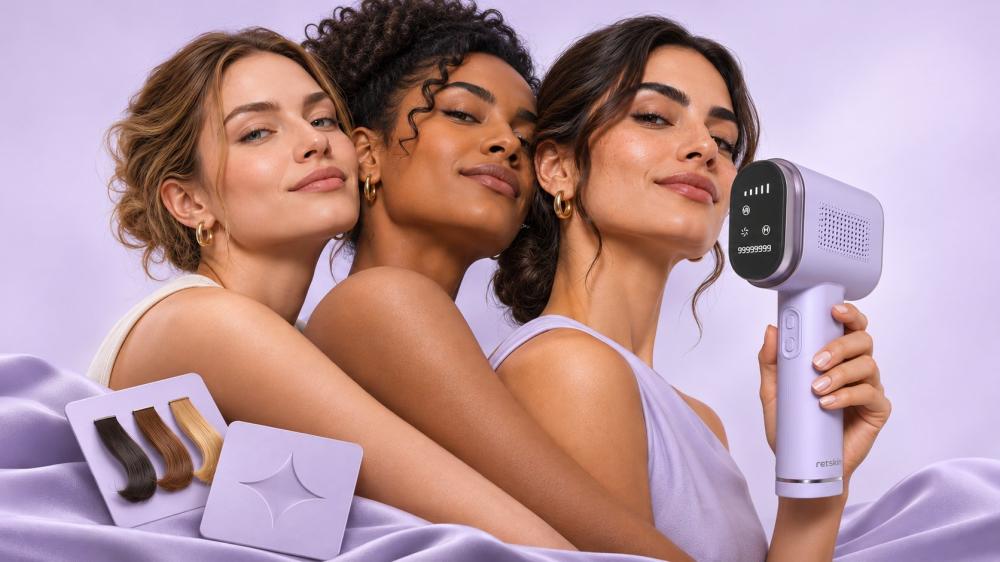
Your skin and hair colour decide two things before anything else: whether home laser will give you a result, and whether it is safe for you to use. The best case is dark hair on fair to medium skin. The closer the skin is to the hair colour, or the lighter the hair, the weaker the result or the greater the need for caution.
This is not a rule for one particular device; it is how light itself works.
Why does the device care about your colouring?
The light looks for the melanin pigment in the hair to turn it into heat that weakens the follicle. But the skin contains melanin too. When the hair is dark and the skin is fair, most of the light goes to the hair. When the skin is dark, it absorbs part of the light itself, which raises the chance of side effects such as changes in skin colour.
If your skin is darker
Many women in Saudi Arabia and the Gulf have olive or tan skin, so this question matters. The honest answer:
- Check the skin tone chart in the device manual before you buy. If your skin tone is within the permitted range, follow the recommended level. If it is outside it, do not use the device.
- Very dark skin needs a different technology. Clinics have laser types designed for dark skin, chosen and adjusted by a specialist. This may be the better option for you, and there is nothing wrong with that.
- Sun-tanned skin is a temporary but important case. The higher risk of side effects does not only apply to naturally dark skin, but also to skin that has tanned. Avoid the sun and tanning beds before sessions, and use sunscreen.
If your hair is light
Blonde, white and grey hair contain little pigment, so they do not absorb enough light, and the result is usually weak or none. Red hair also responds poorly. If this is your hair colour, a home device may not be a good investment for you, whatever its specifications.
Skin tone varies even across your body
The skin on your face is not the same as the skin on your leg, and areas exposed to the sun are usually darker than others. That is why each area needs the energy that suits it.
In the Pro AI, the sensor reads the skin tone at the point of use before every flash and chooses the energy level automatically within the device's levels. But note: the sensor helps choose the energy during the session; it does not replace checking that your skin and hair colour are within the permitted range in the manual in the first place. The RETSKIN team can explain these guidelines before you order.
Suitability chart according to the RETSKIN manual
- Type 1: Description in the RETSKIN manual: pale white. With RETSKIN devices: suitable
- Type 2: Description in the RETSKIN manual: white. With RETSKIN devices: suitable
- Type 3: Description in the RETSKIN manual: creamy white. With RETSKIN devices: suitable
- Type 4: Description in the RETSKIN manual: medium brown. With RETSKIN devices: suitable, and the manual advises brown skin to start at the lowest speed
- Type 5: Description in the RETSKIN manual: dark brown. With RETSKIN devices: not suitable
- Type 6: Description in the RETSKIN manual: deep brown to dark brown or black. With RETSKIN devices: not suitable
Hair colour | With RETSKIN devices
- Natural brown or black: suitable
- White, grey, blonde or red: the device is less effective
Even within the suitable types, the manual advises people with darker skin to use a low flash intensity, because darker skin absorbs more light, which raises the risk of irritation. If your skin is type 5 or 6, a clinic with a laser designed for dark skin is the better option for you.
Frequently asked questions
Does home laser cause pigmentation? Changes in skin colour are a known side effect. They are usually temporary, and more likely with dark or tanned skin, or when sun protection is neglected. Following the suitability chart and the recommended level reduces the chance.
Can I use it on white facial hair? Don't expect a result, because white hair has no pigment for the light to absorb.
Sources:
- Mayo Clinic: Laser hair removal
- North Bristol NHS Trust: Laser hair removal
- Intense pulsed light, Wikipedia
- RetSkin IPL user manual, models T023K and T055KQ: skin tone and hair colour chart.